Friday, June 3, 2016

King's X - Black Like Sunday


After the experimental leanings of the previous two King's X records, the time came for the band to return to a sound closer to its roots while still offering up something more interesting than Tape Head Part II. Dropping in 2003, Black Like Sunday seems like both a bit of an olive branch to longtime fans that were less than pleased with the last couple of albums as well as a sea change in the group's direction back towards the heavier and more grounded sound of their mid to late '90s output.

This return to a straight-ahead hard rock sound was accomplished via a selection of demo recordings first created during the trio's earlier incarnations Sneak Preview and The Edge, rewritten with 20 years' worth of experience brought to bear. The master plan for the record is revealed right from the opening blast of the reassuringly lumbering title track: we're right back in the middle of groove country, and anyone hoping for a return to the Ear Candy era of King's X recordings will be quickly mollified. Black Like Sunday doesn't lay off the gas much through it's runtime as a procession of mid-tempo bruisers come right after the other, mixed in with lighter numbers that present an arena rock-ish, almost glam vibe - "Rock Pile", "Danger Zone", "Won't Turn Back". Here we also have the first 9+ minute long song since the title track off Faith Hope Love in the interesting "Johnny" which flirts with reggae and New Wave sensibilities, a surprisingly excellent slower number ("Down"), and the usual slab of groovy low-riders we all know and love, and Black Like Sunday is right their with the best King's X records when it comes to these: "Two", "Bad Luck", the title track, and "Dreams". Unconventional phrases and ideas are sandwiched into certain tracks and serve as small reminders of their recent past's forays into psychedelia - the crackling phonographic break in "Two Words", dUg's blistering shriek in "Rock Pile", the slow burning breakdown and buildup of "Johnny"'s later half, coupled with the lyrics which betray the youth of the men writing them most flagrantly, all get stirred into the pot to create a hard rock album that's just slightly off center - goofy, almost.

The production isn't as rich or warm as their previous albums and it isn't as adventurous as Manic Moonlight or Please Come Home... Mr. Bulbous, but Black Like Sunday isn't trying to radically experiment with anything - it's King's X putting a fresh spin on the music they've always loved making most, and it's a better experience for it.

C+

Wednesday, June 1, 2016

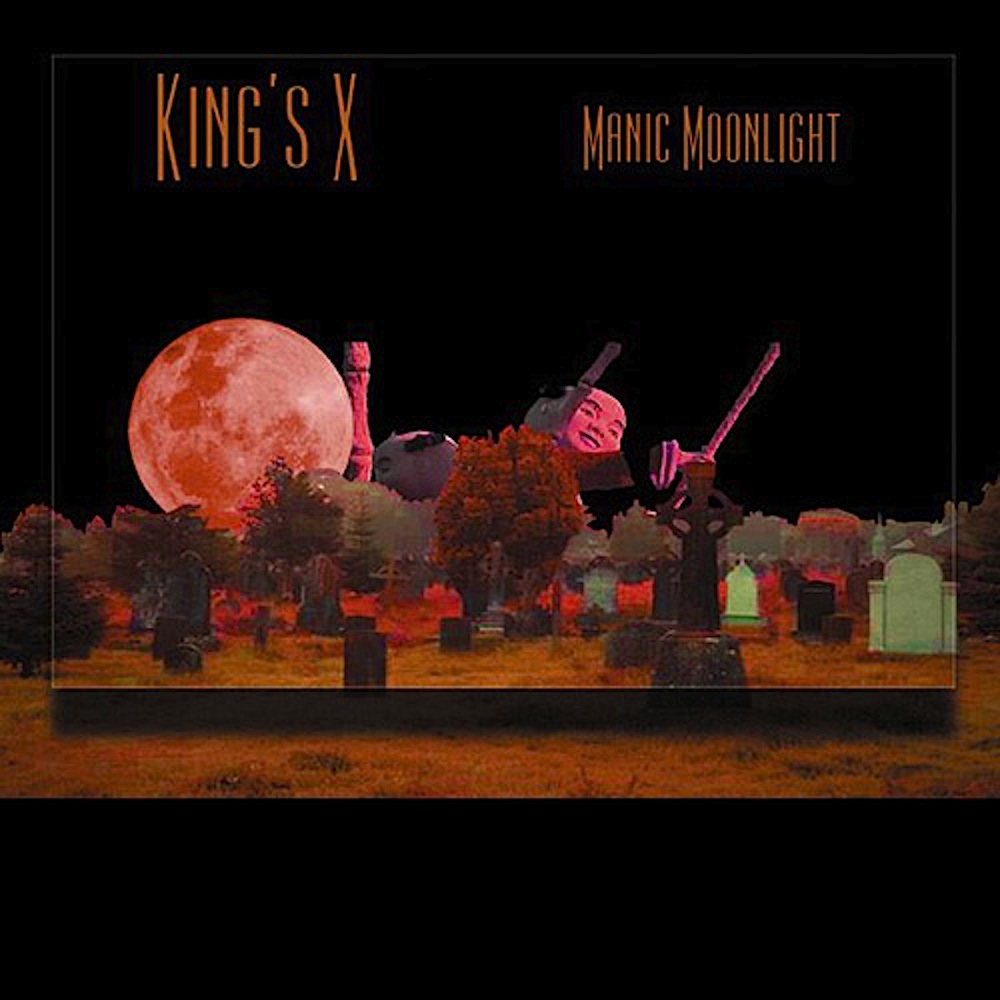
King's X - Manic Moonlight


Breaking the trend of 2 year breaks between releases, Manic Moonlight arrived just a scant year after 2000's excellent Please Come Home... Mr. Bulbous and would prove to be the last disc of original material King's would drop until 2005's Ogre Tones. With such a short break between the two records a degree of similarity could be expected, and Manic Moonlight is much more in the vein of Please Come Home... than their later output, acting almost as a companion piece to the former album.

The main difference is felt in the instrumentation: stripped down bass and guitar lines and a novel use of electronic drum looping gives the tracks a more experimental, alt-rock quality ("Yeah", "Static") that wasn't such an emphasized aspect of their sound until now, and Please Come Home... to an extent. The King's X mark can still be felt on groovier highlights like "Skeptical Winds" and "Vegetable" but the name of the game here is comfortable tinkering with the more laid-back sound they'd been exploring with Please Come Home..., and mostly they succeed in creating pleasant little compositions - the only true clunkers on display are the title track and "Yeah", but the level consistency is high on Manic Moonlight mainly because you know what you're in for right from opener "Believe", for better or for worse.

None of these tracks are too long to be really grating per se, but the extended lengths of "Skeptical Winds", "Jenna", and "The Other Side", coupled with the contractually-obliged 10th song "Water Ceremony" suggest a band running on less than a full tank of gas creatively. Speculation aside, I've always thought of Manic Moonlight as the least essential King's X record - if you skip this one than you aren't missing much, especially if you aren't a fan of Please Come Home....  It's competent and definitely has it's moments, but a seminal moment it is not.

C-

Tuesday, May 31, 2016

King's X - Please Come Home... Mr. Bulbous


While Tape Head signaled the end of King's X's preoccupation with the straight-ahead style of hard rock and poppy grunge first glimpsed on Dogman, they would never really lose their penchant for the groove, and Tape Head's successor Please Come Home... Mr. Bulbous built on the foundation the trio had been laying down the last several albums with the heavier approach they had been taking. Please Come Home... stood out from the band's other work, however, for it's heavy emphasis on psychedelia, both lyrically and in the structure of the songs themselves. If the last couple of King's X records were a bit too much dUg for you, than the larger presence of Ty and Jerry's more esoteric inclinations may be more to your liking.

Lead-off track "Fish Bowl Man" lays the game plan out perfectly and is the entire album in a 4 minute capsule: an pointedly repetitive verse-chorus-verse-chorus structure featuring some very out-there lyrics, capped off with Jerry reciting a poem while the band apes a poetry slam soundtrack before reprising that chunky chorus. The rest of the album sticks close to this blueprint, delving further into outright psychedelia than they've ever gone, before or since. There are still moments of brevity to be found in, primarily in the tunes most clearly penned by Ty Tabor - the excellent "She's Gone Away" and "Bittersweet", while the heavier tunes, primarily "Marsh Mallow Field" and "Move Me", have an honest, almost workmanlike quality in their delivery that makes even lyrics like "A militant mothers, a militant brothers/A militant marsh mellow field" seem weirdly somber - it's definitely different hearing such blatantly bizarre lyrics recited in such a brooding way, and it's another quality that Please Come Home... has that no other King's X album has. You might think that with the word salad lyrics comes hand in hand with looser material, but that's another area that this record delivers the goods in better than it has any right to 8 albums in. From the multi-layered vocals in "Smudge", dUg's scratchy background vox at the back end of "Marsh Mallow Field", to the samples of laughter nestled in the background of "When You're Scared", there is a surprising amount of care taken here to make each song stand on it's own, and the raw material assembled on Please Come Home.. is stronger than any subsequent King's X record.

Clocking in at a modest 44 minutes, it's over in a flash (especially as the last two songs are just two separated halves of the same piece) and never overstays its welcome - almost certainly the most underrated King's X album, especially if you're looking for a lighter experience after their last several albums. The production is just as clear and warm as Tape Head / Ear Candy - at this point in their discography dUg's bass tone is basically pure chocolate, and Jerry continues his reign as secret weapon of this trio. It's mature but not pompous, catchy but not forced, and different in the best way.

B-

Thursday, May 26, 2016

King's X - Tape Head


After 1996's Ear Candy ended King's X's major label run without any noticeable surge in popularity, the band took some time to reconvene and refuel as the members devoted more time to solo records and side projects than rushing out the next big King's X record. dUg dropped Massive Grooves... and provided guest vocals to a track on Dream Theater's 1997 release Falling into Infinity Ty provided his own debut solo album, Moonflower Lane, along with a starring role in supergroup Platypus' first album. When the group began putting together the material that would become Tape Head, they eschewed the direction of an outside producer and wrote nearly entirely in the studio as a collaborative effort between all three members.

The most obvious result of this more free-flowing method of songwriting is that Tape Head is a much more consistent album than Ear Candy as the heavier songs and the lighter ones are all much closer together in terms of tone - "Fade" and "Groove Machine" crunch hard, but "Over and Over" and "Ocean" sound nearly as big in their own right, retaining that distinctive King's X mix of world weary yet hopeful lyrics - the psychedelic word salad of Ear Candy is put on the back burner as the group opts for a more down-to-earth approach. The band has always worn its influences on its sleeve, those ingredients are distilled into a much more distinct flavor with Tape Head.

That said, this is still a post-Dogman record - the focus, as hinted at by track one, is one the groove. "Fade", "Cupid", and "Hate You" are excellent blends of darkness & light a la "Pretend" or "Run", while "Ocean", "Ono", and "Higher Than God" get in and get out before you have a chance to lose interest. The only really weak area of the disc is the end - "Happy" is King's X firing on all cylinders, but "Mr. Evil" and "World" can't quite provide the same kind of payoff of "Pillow" or "Silent Wind". "World" might be the only King's X song that is saved from blandness by a guitar solo, but dUg and especially Jerry are the real prime movers of Tape Head, and they've never sounded better. Between dUg's chocolate cake bass tone and Jerry's propulsive percussion Tape Head sounds like a band that's truly comfortable and in their element, and remains one of the brightest spots in their discography.

B+

Thursday, May 19, 2016

King's X - Ear Candy


After exercising their demons with the brilliant tour de force of Dogman, King's X returned two years later and dropped follow-up Ear Candy to little critical fanfare and what could only have been a disappointing commercial performance after such a return to a form for the group. Unluckily sandwiched between two masterful releases, Ear Candy doesn't seem to have inspired much fond remembrance next to classics like Gretchen... or Faith Hope Love and it after a revisit it seems like an album being pulled in two different directions at once - the trio was clearly keen to experiment more with heavier compositions, but a lot of the material on this disc seems more... restrained, or at least lighter than you'd expect. The tone is more psychedelic than metallic and the album is much closer on the King's X tone continuum™ to Groove Machine and Please Come Home... than to their first four albums.

Things start off alright enough with "The Train" and "(Thinking and Wondering) What I'm Gonna Do" providing the usual balance between rock and ballad before "Sometime" and "A Box" really kick the record into gear. Ear Candy features a lot more dUg than we usually get ("Pictures", "Fathers") and at times feels more like a Poundhound record than a fully-fledged King's X one, but all of them are highlights. Truthfully the only real clunkers to be found here are the ballads: "Lies in the Sand (The Ballad of...)" noticeably drags its feet as Ty croaks out some less than captivating lyrics, and "Life Going By" reminds me of a weaker version of "Silent Wind". The bizarre "American Cheese (Jerry's Pianto)" is the most interesting of the lot thanks to Jerry's lead vocals, similar to "Six Broken Soldiers".

I find it hard to say a lot about this album because it just seems so level in quality (kind of a rarity for these guys). There are good songs, but nothing you'll want to buy the album just to hear. There are bad songs, but none of them are a complete disaster, just... boring. Ear Candy at the end of the day is just too laid back for it's own good and fails to deliver anything truly memorable and is definitely the least essential listening experience this band has created - you really are not missing out on anything by skipping this.

C


Wednesday, May 18, 2016

King's X - Dogman


After years of clocking in time on the outskirts of the rock n' roll mainstream, King's X finally split ties with longtime producer/manager Sam Taylor, who had helped lift the band out of the Houston underground in the late eighties, and cast out on their own, determined to make a record that was more real and more raw than anything they had attempted before. They linked up with a more modern-minded producer in Brendan O'Brien, who was hot off recent successes with Pearl Jam and Stone Temple Pilots. The year was 1993 and grunge was riding high on the hog after leaving the nascent mainstream metal and prog scenes in it's dust, and King's X had about five years of repressed anger ready to be unleashed in what is not just the clearest and most convincing musical document they ever created, but one of the low-key best hard rock albums ever recorded.

Right off the opening beats of the opening title track, it's obvious to all that this King's X was different from the happy-go-lucky boys of yesteryear - this is the sound of a band that is done pretending, and the sonics of Dogman deliver this message perfectly: dUg's bass is the ever-present blacktop upon which the record's wheels roll. Ty's guitar tone is noticeably less distinctive than usual, doubling down on a fuller, rough-edged beefiness alongside Jerry's in-the-pocket beats which have never sounded this well-rounded. The group's distinctive sound is still audible throughout but the components have been disassembled and rebuilt into a chunkier, far heavier configuration, as their trademark harmonies are dialed back to a more atmospheric (and in the case of slower tunes like "Flies and Blue Skies" and "Sunshine Rain", downright hypnotic) element of the whole package. Heaviness is the name of the game as Dogman alternates between towering slabs of crushing riffs bordering on something you'd hear on a Monolord album and cruising-speed foot-tappers drenched in signature King's X catchiness. That the heavier and plainly more compressed sound of these songs greatly elevates them is a big reason why this album is such a success. Good production can do a lot, but that doesn't diminish the contribution of the raw material that went into making Dogman. Songs like "Pretend", "Shoes", and "Sunshine Rain" would've fit in on any previous King's X record, but the new-found aggression and plainly laid-out cynicism of "Black the Sky", "Don't Care", "Cigarettes", and the other heavier numbers are sailing through dangerous waters that had only been teasingly explored by the band on previous outings. Mixing heaviness and heaven was something of a specialty of their's, but the combination of the loud-and-proud freshness of these songs and a set of much more down-to-earth lyrics make Dogman a refreshing experience. The atmosphere is enhanced and preserved throughout the disc's runtime by a reassuring lack of fat on the bone, every song gleaming on a razor's edge of stripped down writing: only two of the fourteen tracks soldier on past the five minute mark, but none of them feel forced or half-baked.

This album's release was basically the funeral ceremony for the "old" style of music King's X gained notoriety with, and they would never really return to the cheery prog-rock-funk of their early days with the same amount of interest. Instead, the next couple of years we see a more experimental side of King's X with albums like Please Come Home... Mr. Bulbous and Manic Moonlight, paired with an increasing preoccupation with the groove - Ear Candy, Tape Head. They weren't able to come up with an album to knock Dogman off the top of the pile, but that's kind of like saying James Joyce never topped Ulysses - no shit. When people talk about masterpieces, Dogman is the record that always comes straight to my mind: like a fine diamond, it's tougher than any material known to man yet seems to be filled with an unearthly light at the same time.

A

Wednesday, May 11, 2016

King's X - King's X


With each successive release it seemed like King's X took two steps forward and one back, each time inching closer and closer to breakout mainstream success, only to have it snatched from their fingers - the consistently high praise they received from critics was never enough to sustain anything more than a larger-than-normal cult following. Album number three, Faith Hope Lope, took them father up the charts than they had ever gone prior, and it seemed reasonable to believe that a follow up of similar quality would be enough to take them over the top and into the promised land.

I've written about this album before, so writing a similar overview of King's X again seems redundant, so just the big takeaways: King's X is a stronger album than Faith Hope Love on almost every level and I'm very surprised that it wasn't more popular than it turned out to be. The songs are shorter and more focused, the production is finally tuned to excellence, and the riffs and grooves are second only to Dogman. Seriously, listen to "Black Flag" and "What I Know About Love" - 'nuff said. The've abandoned the power ballads of yesteryear in favor of softer pieces gussied-up with wisps of synthesizers and sitar flourishes, but you can't win them all I guess. Most importantly, though, is the overall tone: finally, King's X gets mad! Sort of. Not really "mad", I guess, but they've at least cut back on the childlike happiness schtick which had really begun to sour by Faith Hope Love and traded it in for a more grounded point of view bordering on a kind of optimistic cynicism, clearly glimpsed in lean and mean numbers like "Prisoner", "Silent Wind", and the instant classic "Lost In Germany". It has less of the song quality whiplash that plagued their earlier records and is perhaps the most consistent album in their discography.

The other big change with King's X was the end of the band's relationship with longtime producer Sam Taylor at the time of the album's release, marking a significant shift in their sound that would become immediately evident on successive works. His impact on their sound is difficult to pin down exactly as he described his part in the group's trademark sound as quite small: 
"If I did anything, I gave King's X a license to be true to themselves" - Sam Taylor, 1996
More than anything, King's X marked the end of an era for this band and they would never make another record that sounded quite like their first four again - for better or worse.

B+