Tuesday, June 27, 2017

Prey First Impressions


One of my friends is a big fan of slower-paced action games, the kind that emphasize player agency and freedom instead of setpiece moments and cutting-edge design trends. Referred to as "immersive sims", these types of games are an endangered species in today's game development environment with just a handful of studios and projects carrying the torch that Deus Ex and System Shock set aflame - the Bioshock series by 2K Boston / Irrational Games (featuring former members of System Shock creators Looking Glass Technologies), Dishonored 1 & 2 by Arkane Studios (another harbor for former Looking Glass employees), Far Cry 2 by an Ubisoft team headed by emergent gameplay maestro Clint Hocking and GSC Game Worlds' S.T.A.L.K.E.R. series, among others. Prey, the newest title by Arkane Studios, follows in these footsteps with an open-ended design methodology that will feel very familiar to any fans of the 'Shock series or its many children.

The game takes place aboard a space station called Talos I with you filling the shoes of Morgan Yu, who is basically a space-age yuppie caught up in a conflict with your brother Alex and a mysterious race of aliens known as the Typhon who have infested the station. While the premise is new and the CryEngine tech is quite nice looking the core gameplay will feel very comfortable to immersive sim old hands:

  • You start off with a wrench and then can acquire further weapons in mostly whatever order you want
  • You use "Neuromods" to upgrade Morgan's abilities and to unlock new ones. These are basically just Plasmids in space.
  • You are guided throughout the station by a mostly unseen character while picking up audio logs and reading emails to give context to life on the station before everything went to shit (sensing a pattern yet?)
  • Instead of scripted missions, you are given a loose narrative thread to follow and numerous optional objectives to complete at your leisure.
  • The game has several systems you can interact with, including keypads you can hack, turrets and robots you can deploy, items you can craft, and enemies to fight, evade, and scan for research all nested in several expansive hub areas that are partitioned off with loading screens.
Sounds a lot like one of the 'Shock games, right? That's because Prey basically is the System Shock 3 we never got, and it is fantastic if you are a fan of that genre. I'm 12 hours in and I'm pretty sure I'm on the B side of the main plot and I still have several side quests I'd like to wrap up as well as a few more areas to comb through, all while continuing to make tough choices about how to upgrade Morgan and my weapons and making plans in the back of my mind about the strategies I'll pursue when I inevitably run through it again. 

So if this sounds at all like fun to you, I highly recommend Prey. It's on sale on Steam right for $40 and is well worth it for such well-wound package. After I finish it I would like to talk more in-depth about its design but I still feel like there is a lot to learn and absorb with this one, so we'll see when I get around to that.

Sunday, June 18, 2017

Video Games as UBI and the Unnecessariat

Recently I was recommended this article about young guys my age are turning to video games in favor of that old chestnut gainful employment and found it pretty interesting. The rising importance of video games in my demos life doesn't seem very surprising to me, especially considering how quickly we've gone from:


to


The big takeaway: "For Hurst, the pull that games exerted on his son helped illustrate what's happening to young men in the broader economy. Between 2000 and 2015, he said, the percentage of lower-skilled men aged 21 to 55 who had a job dropped from 84 percent to 77 percent, "a massive change relative to historical levels." The decline is particularly acute among men in their 20s. Employment fell 10 points over the same period, from 82 percent to 72 percent. In 2015, he noted, 22 percent of men in their 20s who lacked a college degree had not worked a single day during the previous year—up from 10 percent in 2000." A couple of things here. First, as someone who enjoys video games quite a lot I think it would be insane not to admit their addiction potential (and if that isn't the right term for it I'm not sure what is) - its in their nature as games to be at least somewhat addicting dopamine release tools, they just require a significantly lesser amount of effort than playing a game of basketball or something. Since we all love dopamine (internet porn is pretty big I hear) it tracks that some people will choose to forsake their less-than-dope waking existence, especially if their choice of jobs is between flipping patties at Wendy's or stocking shelves at Ace Hardware and they can maintain a sufficient standard of living by either living with their parents or taking handouts from Uncle Sam. 

If this was really such a historic phenomenon you would think that we have begun to see at least some indication of these missing dudes' presence, but I don't I personally have noticed anything. As far as I can tell houses are still being built, roads are being maintained, and trucks are being driven... but to be fair, the type of guy that this article talks about probably isn't one that I would've really had much experience with in my life regardless. I grew up in a fairly affluent small town in Michigan and was pretty solidly middle-class so college was more of an inevitable thing to be planned for than a potential option among many, and right now I can only think of 1 guy I knew from high school who I know for sure did not go to college, and he is going to be in prison soon so... yeah. This trend of under educated guys dropping out of the workforce like this reminds me of another article I read about a year ago about a torrent of people, disproportionately white, women, rural and not well-off, who are not even "unemployed" at this point. They've been rendered obsolete by technology and automation and are currently committing quiet heroin/alcohol-aided suicide in pretty historic numbers as the global information economy leaves them in the dust (another great piece on this situation). This phenomenon of young men passing by the hours in front of video games seems like a companion piece to what is happening to their female counterparts, and while it certainly isn't ideal I wonder how much worse this will get before it gets any better, since I doubt Amazon has plans to slow down anytime soon. Luckily these gaming fiends seem to be pretty cool with it for now so we won't be seeing molotovs through the windows of Congress just yet, but I'm very interested to see how (if at all) the government begins figuring out new, more constructive pursuits for all of us in the unecessariat after the singularity.

(And yes, I acknowledge that games are a valid entertainment art form just like movies and books blah blah blah, that isn't the issue. The problem is that when you give people a relatively cheap and easy way to feel happy/engaged/challenged like you normally would at some crappy minimum wage job I'm not sure how surprised we can be that they choose illusion instead of reality).  


Friday, June 16, 2017

Living Colour - Stain


A 3 year gap and a shift change in the bass player department didn't slow Living Colour down a bit as they delivered their leanest and most focused album to date in Stain. Shaded more noticeably in metal and grunge influences than anything they had released before, Stain is focused less on breaking through the color barrier of the rock world than it is in showing everyone what Living Colour can do when their sole concern is making music that only they can make. Well, maybe not only they can make, but they certainly have a unique take on the downtuned grunge sound that pervaded the early 90s.

What's more surprising about Stain, though, is how little Living Colour's sound actually changed. The big choruses and foot-tapping hooks came along for the ride, as well as the insanely tight rhythm section of Will Calhoun and new recruit Doug Wimbish (bass duties previously provided by Muzz Skillings) while the whole package is glued together with guitarist Vernon Reid's iconoclastic riffwork and solos, which have never sounded better. Song after song he delivers high-bar guitar work, particularly on the tracks that bridge into solo sections that have a level of groove not seen recorded outside of a King's X album - see "Ignorance Is Bliss" and "Never Satisfied" for ample evidence. Reid's playing recalls John Petrucci's on a raw technical level but his style is purely in the service of the riff on Stain as he pivots effortlessly between heavy blues ("Mind Your Own Business") industrial thrash ("Auslander", "This Little Pig") and even a couple of lower key pieces ("Nothingness", "Bi"). Nearly a quarter of an hour shorter than its predecessor Time's Up, Stain took a hot knife to Living Colour's progressive excess and revealed a filthy, funky skeleton beneath.

Monday, June 5, 2017

Living Colour - Time's Up


Time's Up improves on every aspect of Living Colour's early sound and is up there with King's X's Gretchen Goes to Nebraska as one of the best (and most memorably so) 2nd records. 10 minutes longer than Vivid, Time's Up offers largely the same musical qualities of its predecessor mixed into more interesting and effective compositions by the band, touching on Bad Brains-style hardcore riffing, funk and R & B, and plain old hard rock delivered with a characteristic spin. The material is more diverse and the peaks are higher here, with fewer tracks that feel like a band grasping for an identity. The group's chops are just as impressive as they were on Vivid and the rhythm section of Muzz Skillings and Will Calhoun in particular shines on these pieces, particularly on standouts like "Pride" and "Solace of You". Guest spots from Queen Latifah, James Earl Jones, and others, along with a generous application of samples and a few short interludes help to break up the long stretches of music but at the cost of a runtime that always feels just a bit too long by the time we arrive that the closer. With songs this good I can figure a bit of excess, though, so it doesn't change the fact that this is a fantastic album through and through.

Friday, June 2, 2017

Living Colour - Vivid


An all-black rock band from Brooklyn forming in the 80's that were earnestly pulled along by the chain of the mainstream music machine as a hot new unit well-deserving of fame and fortune, Living Colour is probably simultaneously the most recognizable band of all time and the most forgettable. The story is so cliche its almost too trite to recount: a group of small-time Berklee notables under the stewardship of guitarist Vernon Reid, who was cursed to have his style always described as "eclectic" and nothing more insightful, along with drummer Will Calhoun, bassist Muzz Skillings, and frontman Corey Glover backing him up. Reid's regular presence on the international jazz circuit caught the attention of Mick Jagger who took a shine to the group and became interested in producing their first album, which was released in 1988 to critical and commercial acclaim, chiefly off the ample carrying capacity of lead single "Cult of Personality", which sits lazily at rest up there in the clouds next to "Highway Star" and "Career of Evil" in the pantheon of legendary opening album tracks. The rest of the album is unfortunately a bit light on the ground as the excellent "Funny Vibe" and so-good-I-didn't-even-realize-it-was-a-cover "Memories Can't Wait" do what they can to prop up the more quizzically played-straight numbers like ballads "I Want to Know" and "Broken Hearts". The groove is definitely real on the more metallic pieces ("Middle Man", "Glamour Boys") but there is feeling of the band holding back throughout Vivid, but that could just be me projecting. Regardless, Vivid remains a solid introductory effort thanks to the strength of a couple of choice singles which seemed to have given the band the time and budget they needed to fully realize their sound on disc numero dos.

B- 

Tuesday, May 2, 2017

Starsector

Starsector is a 2D open-world space exploration/combat/trading sim with role-playing elements. It first entered development in 2010 and I originally bought it as an "early access" type game (before Steam had taken that concept to into the mainstream and ruined it) around 2012, back when it was still in a very early stage of development and was going by a different name, Starfarer. Back then the game was a solid little 2D space combat sim with only a few light open-world exploration mechanics I played around with it for a bit but lost interest due to the long development cycle and lost track of it around 2014.


A few weeks ago I randomly remembered Starsector and decided to check it out and see what it looks like nowadays after 3 years out of the loop. As luck would have it just a few days later a major update to the game dropped, adding and improving on several features that had been apparently cooking for quite a while that fundamentally altered and fleshed out the core gameplay loop, turning it into something more than just a 2D space combat sim. Back when I was playing the main "objective" was just to fly around with your fleet, battling other factions' ships while accumulating money and enough resources to improve your own fleet so you could take on progressively larger fleets and armadas. Combat took place in discrete little arenas in real-time while you could pause the action to issue a wide range of commands to your fleet ranging from attack orders to escort assignments and rally points. This gameplay loop hasn't changed too much but instead has been augmented with a couple layers of additional mechanics like:

  • Scavenging: Drifting derelict ships, dormant automated probes, space stations long dark and other objects are now sprinkled throughout the various star systems waiting to be discovered. These are often the subjects of missions but can be sought out independently while roaming about as well, and they often contain valuable rewards. Good stuff.
  • Surveying: Also the subject of missions, uncharted worlds can be surveyed and cataloged freely to obtain detailed data on a couple of factors like amount and types of natural resources, habitability, etc. This is also an activity that is easy to do while just exploring random systems and can yield some major dosh.
  • Missions: I think these have been in the game for a while now, but this has been my first experience with them so I think it makes sense to include them here. These are simple single-objective tasks that send you to survey or scan distant targets in far-flung systems or deliver X amount of Y good to someone somewhere. Not particularly complex but they do a decent job of providing an incentive for exploration, which is the game's real strength because it allows the emergent potential of its mechanics to come up. You also have the option of taking a "commission" with one of the game's several factions which gives you a reward for destroying that faction's enemies while making those enemy factions immediately hostile to you. This basically lets you join a faction.
  • Bounties: Similar to commissions, but these are constantly being posted by various factions and individuals for different targets all over the map. They seem to be split between general "Destroy X faction's enemy ships in Y area, get $$$" and taking out specific named NPCs commanding fleets ranging from 3-4 small frigates to enormous armadas. 
When I first played Starsector there were 3 factions: The Hegemony, which are kind of like the Imperium of Man from 40K without all of the gothic horror or kind of a low-tech Galactic Republic. Basically, the space government. There was also the Tri-Tachyon Corporation which was the Hegemony's rival and the designated "high-tech" faction and a Pirate faction, but since you couldn't ally yourself with them I guess they don't really count. Nowadays there are several additional factions present all with their own relationships to the others that you can undertake missions, bounties, and commissions for who are all out and about in the game's overworld, constantly battling each other (and you as well depending on your relations with them). This overworld is referred to in-game as "hyperspace" and it's kind of like a freeway system for space travel that sees a buzzing level of activity as enemy fleets duke it out (feel free to join in and assist your allies), smugglers and scavengers skulk around looking for their next big score while pirates and fanatic techno-religious cultists (one of the new factions) roam the void in search of victims.
 
Starsector's current map size as of version .8

The list of tweaks and changes goes on: a revamped skill tree, a substantially more fleshed out UI and lore, new skills and ways of navigating the game's enormous space, and a fully discrete tutorial that, while not perfectly successful in bring new players up to speed with everything going on, is an enormous step in the right direction and I find myself continually impressed with what has been accomplished here with such a small team as Starsector's developer, Fractal Softworks, is made up of just one full time dude and a handful of part time contributors. Then when you see the game's modest $15 price tag, relaxed system specs, and brilliant modding community, its just great to see a game with such a cool concept as this not succumb to the myriad ticket-punchers that end so many other early-access games. Starsector has come an enormous way since its very humble beginnings and I haven't even mentioned several of the other new things included in the latest version. This is simply early access indie development done so, so right.

Tuesday, April 18, 2017

More Mad Max Thoughts


I was thinking about the Mad Max game earlier (since apparently I'm turning into the Joseph Anderson of Mad Max) and I kind of came to a realization as why I thought the game felt it too safe, and it has to do with the cars (specifically Max's car, the Magnum Opus). See, in the movies it's made pretty clear that cars = life in the Mad Max universe and shiny new F-150s aren't exactly growing on trees. This is pretty obvious to anyone who's seen any of these films (especially Fury Road) but I think it's worth pointing out that cars are put on a seriously high pedestal in this franchise, and not just in the The Fast and The Furious kind of "these cars are real fast and look cool" way -- they're really more like horses, with names and personalities that haven been customized to the owner's tastes over the years, but far more valuable since you can't just wander out into the outback and lasso a car to replace the one that just got wrecked. Max's Interceptor in The Road Warrior is equipped with a bomb that will go off if anyone tries to siphon his petrol and we're shown several times in Fury Road that all of the vehicles in Immortan Joe's fleet have detachable steering wheels, unconventional fuel modifications, and in the case of the War Rig, a dead man's switch preventing ignition without a special sequence of switch flips. It's shown quite clearly to us how valuable and irreplaceable many of these vehicles are, so I think it's a real shame that Mad Max the game doesn't really continue with this theme and instead kind of goes in the opposite direction.

For starters, Max is able to steal any enemy vehicle with just a single button press - evidently they thoughtfully drive around with their doors unlocked all the time. This is pretty silly just in the least immersion-breaking case of you being able to theoretically sneak up on a guy and steal his car leaving him stranded in the desert (this never happens). It gets hilarious in practice however as, if you can get the timing right, you can pull enemies right out of their own cars while they are still moving. Often these car doors are festooned with rusty spikes and jagged tips probably intended to prevent this exact scenario from occurring, but whatever, they probably originally built the game to not let you perform these carjack stunts but in testing people hated getting run over repeatedly without any recourse so... there you go. This still would've kind of silly and dumb if the enemies were allowed to do this to Max's car as well, but no, instead of trying to give Max a taste of his own medicine enemies will just hop onto your car and try to kick you / punch you / stab you to death. This is a real bummer as you're frequently forced to get out of the car and leave your sidekick / mechanic buddy Chumbucket all alone and defenseless, but since none of the enemies can actually hurt him there's really no danger at all, even though Chum has lots of incidental dialogue about how scared he is, how dangerous the area you're in is, etc. It feels like a pretty obvious idea so I'm guessing Avalanche Studios at least thought about this but it's a shame nothing made it into the final game as that added tension of needing to protect Chum and the car would've added a lot of white-knuckle moments as you race back from whatever you were doing to save him before some scavengers run off with your Magnum Opus and erase about 15 hours of progress. What would've been really cool, is if at that point you have would've had to repeat some of the introduction missions of the game and gone back to the Boneyard, grab another of the 5 car bodies, and try again with a stock Opus. Maybe too punishing since you're asked to get out of your car a lot, but still probably would'be felt more in line with a post-apocalyptic hellhole than what we got.

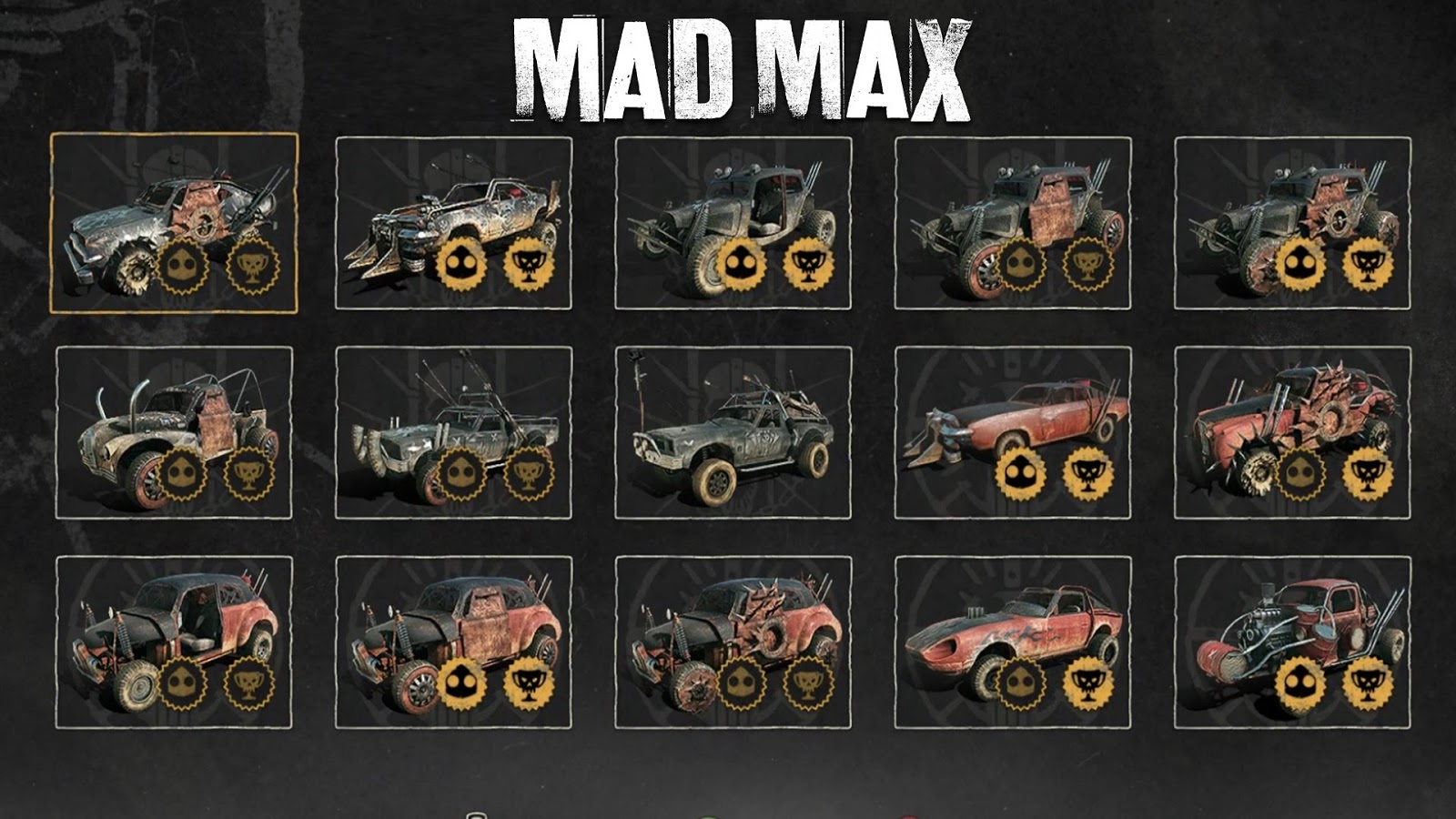
The other aspect that the game slides backwards from in relation to the films is enemy variety. I don't mean the variety of the enemy factions as those are actually fine even if they are all kind of same-y - I mean the cars. For a Mad Max game there is a dishearteningly small pool of included car designs that you will encounter way, way too often by the end of the game, and it's so fundamentally at odds with the universe this game takes place in and the generally accepted ground rules of post-apocalyptic media that I honestly believe that this was just a result of Avalanche's inexperience with making a Mad Max game, as this is an issue that the developers must have been reminded of time and time again as they were putting this game together.

 
This isn't every vehicle in the game, but these are definitely the most common ones you will see in your time in the Wasteland. Notice the repeats? Yes, every vehicle has totally separate entries in this menu for its "no armor", "some armor", and "tons of armor" versions (as you progress through the areas of the environment and get closer and closer to Gastown, the enemies get tougher. In this case "tougher" just means "has more health" but whatever, you will see 13 of the vehicles on this page so often that they are honestly the only enemies that exist. What's worse, there is a lot of overlap between enemy factions here: 3 factions have a heavily armored car with shredder tires (top left, far right middle row). 3 factions have a "rammer" car with a huge cowcatcher and distinctive exhaust (2nd from left, top row and 2nd from right, middle row). 3 factions have a similar looking coupe-type vehicle with a flamethrower mounted in the back (far left, middle row, 2nd from right bottom row). 2 factions have pickup trucks filled with dudes who try to board your car (2nd from left, middle row). And then all 4 factions have their own front-line "infantry grunt" vehicle that makes up the bulk of convoys and a significant portion of patrols (right 3 top row, left 3 bottom row). The excessive repetition stings even more considering that many of the vehicles are modeled after the cars featured in Fury Road, a film where you couldn't find a repeated car model with a gun to your head.

Like the issue with Max's carjacking and Chumbucket's invulnerability, I'm sure the obvious solution to this was already thought of by the developers (obvious to me, at least): take the Nemesis system from Shadow of Mordor, and reshape to generate random procedural enemy vehicles instead of Orcs. This is almost certainly an insane amount of work however, so I can understand why they weren't able to do something like this as I'm sure they recognized the potential of semi-random convoy or camp leaders for Max to take on. What is interesting to me is that there hints of a more modular car customization system a la Mafia II that exists, as a there are certain late-game vehicles that belong to a smaller faction which are like twisted, even more souped up versions of the "regular" enemy vehicles seen in the image above. These vehicles strangely are the only ones in the game that you cannot capture for yourself and feature some very cool and unique parts and chassis, so it's a bit of a bummer that they weren't able to do more with that - maybe since each "region" of the map is under the control of a leader who specializes in certain aspects of car combat (one is all about armor and tires, another is all about engines and exhausts, etc."), the enemies in that region maybe could've had distinct, unique customizations in order to survive against the leader's people. Which brings me to another strange piece of this game: the people.

Throughout Mad Max, you do most of what you do in order to help the people of the Wasteland. Whether that's taking over outpost camps, wrecking convoys, or clearning minefields and etc., it's all ostensibly to further Max's own personal goals while helping the "normal" people of this world get out from under the thumb of the game's antagonist, Scabrous Scrotus (yes, that is really his name). And to some extent, your progress is tracked and reflected in the game world - the "threat level" of each area goes down, reducing the frequency of enemy patrols, and whenever you take an enemy camp it's repopulated with friendly NPCs who are for some reason shown dismantling everything. Yes, even in the post-apocalypse where water is more valuable than gold you can stand and watch these people for hours hack, saw, and grind away at the metal structures that can only have been put together with countless man-hours and resources. It doesn't make any sense and the game only gives this lame "we have to make it so there's no reason for them to come back" excuse as a hand-wave, but that makes even less sense. No one has guns in this world (except snipers. Snipers with fully-functioning rifles are littered all over the place but Max possess literally the only other firearm you will see in the game) so what are they going to do? Ram their cars into the outpost? It would've made way more sense if, every time you captured a camp, you had to defend against an inevitable counter-attack - kind of like the 2nd stage in a boss battle. And depending on the amount of perimeter defenses that you destroyed on your way in (stuff like flamethrowers, snipers, and bizarre automated turrets) the fight would be easier or harder since the people you liberated it for might not have enough tools to push back the enemies. That could've fed into a larger system of territory control for each region's leader in a similar way to the gang fight mechanics from GTA. As it is now you just kind of clear out camps and the enemy factions just kind of accept their losses and leave you and the camps alone in a very un-Fury Road manner. Just having something really small like the outpost retaliation mechanic in Fac Cry 4 would've gone a long way towards making this seem like more of a constant struggle that Max and the player are helping out with instead of the one man army conquest that it is now.

This is getting long and kind of ranty so I'm going to end it here, but I might write something about the car combat as well since it's mostly good but way too easy and has some strange quirks about it. We'll see.